- Home
- About the Project
- Explore RINAP Home Page
- Browse Online Corpus
- Access RINAP 5 Scores
- Access RINAP 5 Sources
- Using the RINAP 5 Corpus
- RINAP 5/1 Front Matter
- RINAP 5/1 Introduction
- RINAP 5/1 Text Introductions
- Prisms Part 1 (texts 1-7)
- Prisms Part 2 (texts 8-13)
- Prisms Part 3 (texts 14-20)
- Cylinders (text 21)
- Undecorated Wall Slabs (texts 22-23)
- Epigraphs Part 1 (texts 24-29)
- Epigraphs Part 2 (texts 30-39)
- Epigraphs Part 3 (texts 40-49)
- Epigraphs Part 4 (texts 50-58)
- Paving Stones (texts 59-60)
- Stone Tablets (text 61)
- Lapis Lazuli Tablets (text 62)
- Statues (text 63)
- Stone Bull Colossi (text 64)
- Seals (texts 65-67)
- Stone Vessels (texts 68-70)
- Glazed Bricks (text 71)
- RINAP 5/1 Back Matter
- RINAP 5/2 Front Matter
- RINAP 5/2 Introduction
- RINAP 5/2 Text Introductions
- RINAP 5/2 Back Matter
- RINAP 5/3 Front Matter
- RINAP 5/3 Introduction
- RINAP 5/3 Text Introductions
- RINAP 5/3 Back Matter
- Oracc Lemmatization Colors
- Citing RINAP URLs
- Reusing RINAP material
- RINAP Downloads
Inscriptions on Lapis Lazuli Tablets (text no. 62)
62
A small, badly damaged lapis-lazuli tablet that may have served as an amulet is inscribed with a short dedication to a deity, most likely Marduk (based on the preserved epithets).
Access the composite text [http://oracc.museum.upenn.edu/rinap/rinap5/Q003761/] of Ashurbanipal 62.
Commentary
The tablet, of which only the left portion remains, was discovered at Nineveh by R. Campbell Thompson (find spot not recorded). Each line of text is separated by a horizontal ruling. The script is a mixture of Assyrian and contemporary Babylonian sign forms, with Assyrian forms predominating; this is typical for Assyrian inscriptions written on stone.
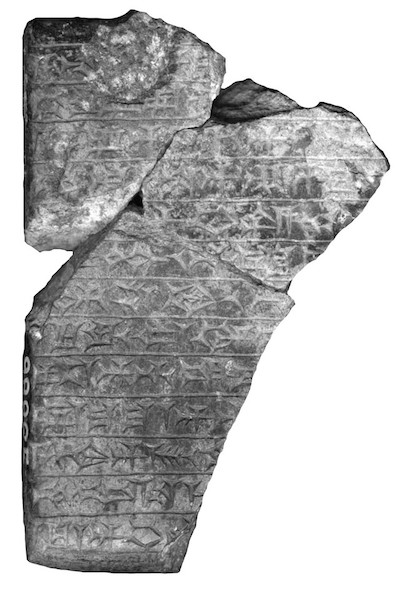
Obverse of BM 98865 (text no. 62), a lapis-lazuli tablet inscribed with a text addressed to the god Marduk.
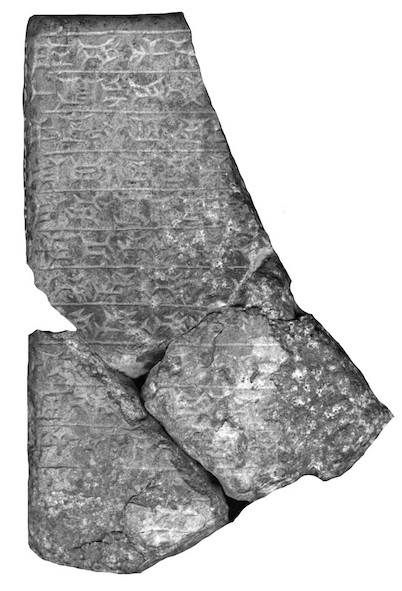
Reverse of BM 98865 (text no. 62), a stone tablet of Ashurbanipal found by R. Campbell Thompson at Nineveh.
Bibliography
Jamie Novotny & Joshua Jeffers
Jamie Novotny & Joshua Jeffers, 'Inscriptions on Lapis Lazuli Tablets (text no. 62)', RINAP 5: The Royal Inscriptions of Ashurbanipal, Aššur-etel-ilāni, and Sîn-šarra-iškun, The RINAP/RINAP 5 Project, a sub-project of MOCCI, 2025 [http://oracc.org/rinap/rinap5/RINAP51TextIntroductions/LapisLazuliTabletstext62/]